17 Airlifted to the Emerald Island

Helicopter Airlift

Airlift to Safety.

The skies were crystal clear, the sun was brilliant, and the ocean winds were calm that day in dramatic contrast to the previous three days of cold, tumultuous seas driven by gale force winds.

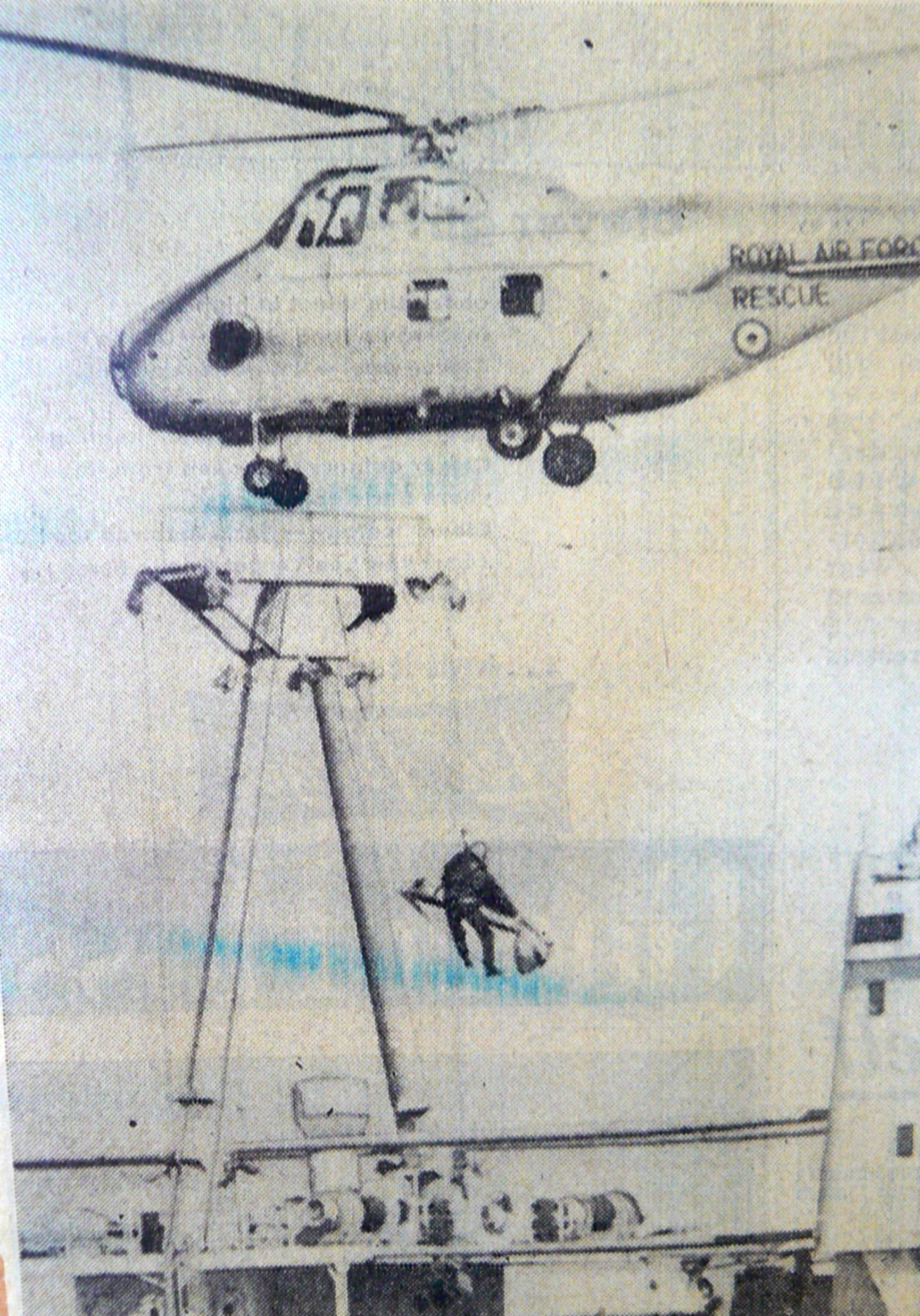
The Swiss rescue ship Celerena lay some 8 miles off the point known as Galley Head off of the south-west coast of Ireland. Two bright yellow ambulance helicopters of the British Royal Air Force stood by to initiate an airlift of 17 most seriously injured survivors* of the ditching of Flying Tiger Flight 923.

From Galley Head point, the distance to the brand new Cork Airport was some 29 miles across some of the greenest hilly farm country in the world. According to reports, the first airlift took an hour and 23 minutes. Sixty of these minutes were spent in actual flying time and 23 minutes in taking the injured on board from the ship. Continue reading

Posted in new combat troopers, passengers, rescue teams | 2 Comments

Elizabeth Sims Cannin: Newlywed attendant shows bravery on her final flight

“She asked us, as a routine precaution to get our life jackets
out of our seat pockets. Miss Sims and her three assistants,
Carol Ann 
Gould, Jacqueline Brotman and Ruth Mudd,
helped us into the life jackets and led us through
ditching drills . . .
 She kept telling us that this was just
practice and there 
was no emergency. I doubted it.”

Chief Stewardess Elizabeth Sims Cannin was named in most publications only as Elizabeth Simms. Before she died in the Atlantic crash landing, she told her family that the flight was to be her last. She told of her plans to leave flying when she visited relatives in Highland Park, Michigan. She said she had given the Flying Tiger Lines 30 days notice. She was married just one month before the crash and had told only but a very few of her closest friends. Her new husband was a commercial pilot.  Continue reading

Posted in flight crew | Tagged , | 2 Comments

One light – One raft – 51 people

“Then I had an inspiration.
I went back to the cockpit for a flashlight. 
By that time
 the water in the cabin was waist deep.
No one else was in the plane. Again at the back door,
I was swept out to sea by a wave.”  — Capt. John D. Murray

The fate of 51 passengers in a 15-foot wide, rubber life-raft, built for 25, was at stake. One simple flashlight helped guide spotter planes and the Swiss freighter Celerina to the critical point of interception and rescue.  Gale force winds swept the craft without a sail some 22 miles over six hours. Continue reading

Posted in flight crew, new combat troopers, passengers | Tagged , | 5 Comments

Mac Johnson: He will not be forgotten

“A Mesa, Arizona mother held a flicker of hope today
that her son would be found some 500 miles off the coast of Ireland
in the teaming, stormy North Atlantic.”

Pvt. Carroll M. Johnson, son of Mrs. Gracie M. Medlin of Openshaw Dairy, Mesa, AZ was one of two Valley paratroopers aboard the Flying Tiger Super Constellations that ditched in the North Atlantic Sunday night, according to a local Phoenix newspaper. The story continued with “Of the 76 aboard, 28 are known rescued, 12 known dead and 16 known missing.” Pvt. “Mac” Johnson was missing.

She and her husband Robert sat listening to radio reports of the rescue operation, some of which erroneously said her son was saved. They clung to hope Continue reading

Posted in new combat troopers | 10 Comments

Samuel Vasquez: Big bang blacks-out trooper

There wasn’t supposed to be a big bang. The plane was
expected to glide across the water surface, coming to a controlled halt, allowing passengers to step out onto the wing and load into
the life rafts. But that didn’t happen.
The Tiger hit the water with one gigantic big bang.

Two paratroopers from the Phoenix, Arizona metropolitan area were reported missing that first dreadful evening of the ditching of the Flying Tiger, Sunday, September 23, 1962. Both combat paratroopers were Army engineers headed for assignment in Germany. They were Pvt. Sam Vasquez and Pvt. Carrol “Mac” Johnson.

Both of the troopers’ families waited, prayed and hoped Continue reading

Posted in new combat troopers | Tagged , , , | 1 Comment

CAB Report Available for Free Download

Thirty seven pages, single sided, in 1962. How big would
this report be today, 50 years later?

A complete copy of the “Aircraft Accident Report by the Civil Aeronautics Board,” released September 13, 1963 is available here in Adobe PDF format. It is entitled, “Lockheed 1049H N6923C, The Flying Tiger Line Inc., Ditching in the North Atlantic, September 23, 1962.”

This 37-page report (single sided pages) on the ditching of Flying Tiger 923, is available, free: (click here to read on line or to save to your own computer – allow a few seconds for loading).  cab_report37pgs

Consider how large this report might be if produced in our current social environment some 50 years later. Would this report still be 37 single-sided pages long? Or might it be 37 pounds in weight? Or, perhaps, might it be 37 truckloads of testimony and evidence?   cab_report37pgs

Again, the complete report on Flying Tiger 923: 

Posted in flight crew, new combat troopers, passengers, rescue teams, Uncategorized | Tagged | Leave a comment

Capt. LC Lugli and Anthony Neumann: Reminiscences and Complications of a Rescue at Sea

In the chaos of foam of the sea and the wave crests,
suddenly appears in a small 
clear light, certainly that of a torch
in hand. On it we direct cone reflectors that 
reveal a life raft
captured between the waves that slam back and bend it, 
sometimes like a blood sandwich.

Reminiscences and Complications of a Rescue at Sea
As told by Captain LC Lugli and Chief Engineer Anthony Neumann.
Published in Nautica 528, in Italian, April 2006.
(Translated into English from the original document written in Italian.)

The M / V “Celerina”, the Swiss flag, with a cargo of wheat from Manitoba on board and sailing from Port of Churchill (Hudson Bay, Canada), hit the Atlantic direct to Antwerp. The crew is mixed, consisting of Italian, Swiss and Dutch. Commander is Captain LC Lugli of Chiavari. The writer is chief engineer Anthony Neumann.

Entering Rough Seas

In the evening, we are approaching Europe on a heavy sea and strong wind from the northwest caused by a sudden storm. The ship does not even feel immersed due to the rough seas. Continue reading

Posted in rescue teams | Tagged | 4 Comments

Art Gilbreth: Out of body experience guides trooper

I found myself in two planes of existence.  One was floating way high above me and could see everything:  the sinking plane, the raft, people swimming, and me underwater.  The other plane was at my level and I was under water.  The me-above was giving instructions to me below in the form of a low voice in my head.

 Here is my story of Flying Tiger 923
by Art Gilbreth, survivor

This was to be the seventh time I had ever been in an airplane.  I jumped out of the first 5 flights. Then I had a flight that landed once. On this flight, my seventh, I ditched in the North Atlantic.Not the best of records. In all, the trip from the states to Germany took me a bus> a Super Constellation> a rubber raft> a Swiss Merchant ship> a helicopter> a Canadian Aircraft carrier> and another bus to Germany.

Aboard Flight 923: I had a window seat right behind the right wing.  I seem to remember that behind me was a lady with 2 kids.  Continue reading

Posted in new combat troopers | 4 Comments

Samuel Nicholson: He controls launch of life raft

“I pulled open the rear door and a wave at least 10 feet
high knocked me over. I got up and threw the un-inflated raft out
of the back door. Unfortunately the rope which was tying it
to the aircraft and intended to inflate the craft snapped,
and it began floating away.”

Navigator Samuel T. Nicholson, age 32, from Dallas, PA, is a difficult man to write about with an appropriate justice. Fifty years later, it is difficult to find more detail than that

Navigator Sam Nicholson

Navigator Nicholson

which was reported in newspaper and magazines, and in all, that wasn’t very much. But here is what this writer was able to glean out of old sources:

Samuel Nicholson was the person who made final contact with the ultimate rescue ship just minutes before the ditching. He told Captain John Murray that the Celerina was the closest ship to where they would ditch, about 50 miles away. Captain Murray gave him is final orders in preparation for the collision.

As the wounded Super Constellation glided erratically to its ditch point of contact, Nicholson moved from the cabin to the back door, where it was his mission to open the rear door and toss out the in-board life raft. Four other life rafts stowed in the wings would be Continue reading

Posted in flight crew, rescue teams | Tagged | Leave a comment

Bonaventure: The invisible giant!

It was accompanied by five destroyer escorts,
the Aircraft Carrier Bonaventure.
In total, those ships accounted for a gigantic amount of naval
tonnage, 
manned in total by several thousand sailors and
air force pilots. It was there to 
support the rescue,
which it did superbly. Thanks to the Canadian Navy!

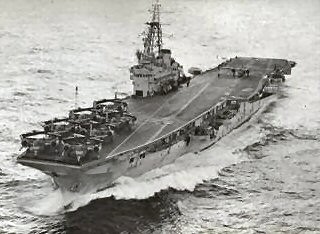
Virtually none of the survivors had a chance to see this key player in the rescue of Flying Tiger 923, and many had no idea that it was there at all. The nearly invisible, but vital, player was the Canadian Aircraft Carrier Bonaventure.

The Bonaventure

The Bonnie

The Bonaventure intercepted the SOS from the crippled aircraft, however it was several hours behind the Swiss Freighter Celerina. None-the-less, the “Bonnie” changed course and headed to the crash scene.

At the time of intercepting the SOS, the Bonaventure was steaming east toward Rotterdam with five destroyer escourts: the Crescent, Athabaskar, Cayuga, Mirmac and Nootka. The carrier, with escort Athabaskin, immediately altered course toward the scene of the disaster. Aircraft from the Bonnie were over the search area shortly after dawn on Sept. 24 and the two Canadian warships (the Bonaventure and Athabaskin) reached the scene Continue reading

Posted in rescue teams | Tagged , , , | 36 Comments