Gordon Thornsberry: Mother’s scrapbook provides details of North Atlantic crash

Written and submitted by Gordon Thornsberry, Russellville, Arkansas

Prologue

My mother had a scrapbook on the crash which I inherited when she passed away. The scrapbook included telegrams, newspaper clippings, photos and a letter I wrote to my family detailing my experience. The letter had been passed around and read by family members. The numerous tears eventually caused wording to smear making the letter barely legible. I say this knowing that there were forty-seven other letters meeting the same fate. We, the survivors, know what happened to us but our families went through periods of time not knowing our fate. Our families were lucky.

Following is my account written less than a month after the crash in a letter to my family: October 14, 1962

Dear All,

Hope this finds everyone okay. Sorry I have waited so long about writing but since I have been here I have really been busy.

Germany is really a beautiful country. Every plot of ground is growing something or is being plowed. Everybody has flowers around their house or sticking out their windows. Over here you have to worry more about getting hit by a bicycle than you do by a car. You see people regardless of age riding bicycles. Continue reading

Posted in new combat troopers | Tagged , , , , , | 2 Comments

Survivor and two rescuers meet in Swiss village of Celerina

Village of Celerina welcomes reunion.

1962 plane crash survivor Fred Caruso (center) meets two of his rescuers Walter Wunderlin (left) and Pierre-Andre Reymond (right) in the Swiss village of Celerina.

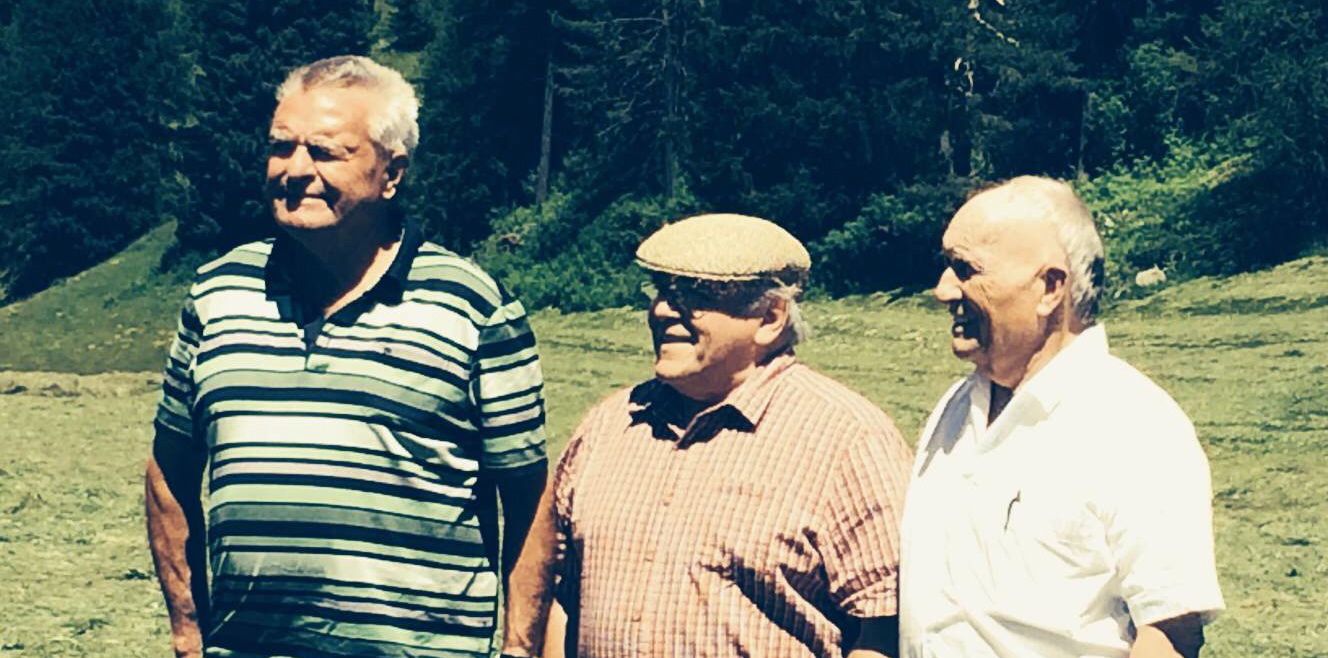
A tiny village in the Swiss Alps was the site of a reunion on July 18th of a North Atlantic airplane crash survivor and two of his rescuers. The village of Celerina welcomed Fred Caruso, Pierre-Andre Reymond and Walter Wunderlin who first met six hours after the September 23, 1962 crash. That was when the Swiss freighter MS Celerina, named for the Swiss village, intercepted and plucked Caruso’s life raft packed with traumatized survivors from the storm-swept seas.

At the time of the crash, Caruso was 21 years old and was one of 40 U.S. Army paratroopers flying from Maguire Air Force base in New Jersey to Frankfurt, Germany. There were a total of 76 men, women and children aboard. Twenty-eight of those perished. Continue reading

Posted in Uncategorized | 6 Comments

Mother and two children lost in raging sea

“I saw a child being thrown out a window by a man
after the plane hit the Atlantic. The child was never seen again.
The other child also vanished.”

Hoopii

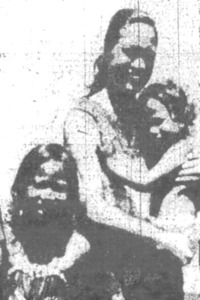
Rachael Hoopii with children

Rachael K. Hoopii, 32, of Waimanolo, Hawaii was on her way with two children to join her husband in Munich, Germany. Mrs. Hoopii and her little girls, Uilani, 10, and Luana, 6, were all eager to see the family together again.

Tech. Sgt. Bernard Palinapa Hoopii, 36, of Wailuku, was energized, excited for his family’s arrival. He was a veteran of 12 years of Army service, which included action in Korea. He had been separated from Rachael, Uilani and Luana for the past two years.  Bernard and Rachael had been married for six years. Continue reading

Posted in passengers | Tagged , , , , , | 5 Comments

Air Force Captain reflects on ditching-day horror

[A number of stories were written about Dr. Figueroa, with nearly all focusing on his untiring and heroic ministering to the medical needs of fellow survivors. This is his story. It is about his experiences and feelings about the flight and demise of Flying Tiger 923 on the very day of the ditching in 1962, but written 52 years later. He has given us the right and encouragement to print the story as he he wrote it.]

By Dr. Juan Figueroa-Longo, MD

On September 22, 1962, my wife, Carmen Amato (qpd), and I left Turner airbase located in Albany, Ga. I was the Director of the Department of Obstetrics and Gynecology at the base hospital. Turner AFB was part of the Eighth Air Force and was a grassroots network in the eastern United States with headquarters in Westover, Mass.

Our destination was Frankfurt, Germany where from there we would spend two weeks holiday between Germany, Switzerland and Italy. These holidays were granted by Colonel Francis Fardy, Commander of the Base Hospital as recognition of the work done the previous year when we were understaffed and overworked, but achieved excellent results.

A few weeks earlier we bought through an agency in NY a new Volkswagen ($ 1,600.00 at the time). We would pick it up at the factory in Wolfsburg, northeast of Frankfurt.

The day we left Turner AFB, we flew on MATS (Military Air Transport Service) to McGuire AFB in New Jersey.  From there we would get another MATS flight to Frankfurt.

Arriving at “Base Operations” at McGuire, we were informed that at present there was no scheduled flights to Frankfurt that day, but there was one for Lyon, France. That plane was a 707 Trans Caribbean Airways plane leased by the military. We decided to wait for a direct flight and were instructed to go the Officers Quarters and settle in. We would be notified of the availability of a direct flight to Frankfurt.

Around 3:00 AM we were awakened and advised by telephone that there was a flight coming in and it had seating available. Quickly we went to check in Base Operations to see if it was so. After the routine paperwork we were informed that the flight would leave around 7 AM with a refueling stop in Gander, Newfoundland .

We were called for boarding at the scheduled time. Going up the ladder on the left rear of the ship, I could not avoid noticing that the door I looked dirty. While entering, I was looking at the ceiling and noticed it was of a plastic material and was tearing and ripping. The tears were patched with plastic tape.

Once inside I saw the seating arrangement, which, like other aircraft of that class, consisted of rows of two seats on the left side and three seats on the right. We were assigned two seats an the left side, where there was a window for emergency exit at rows 4-5. Carmen sat on the seat facing the window and I took the isle seat looking over the cabin.

After routine instructions the plane took off to Gander, Newfoundland.

Minutes after takeoff I heard a voice from the back of the cabin speaking loudly, “I can see daylight thru the door.” A stewardess went to the back door to look, and without comment, she went back to the cockpit.

Years later I met fellow passenger Master Sergeant Ernest Wilson, of New Orleans in San Juan, Puerto Rico. In recalling the ordeal, Sgt. Wilson confessed that it was he who made ​​the comment about seeing light through the door.

As we boarded the plane, some passengers took a second look at us because we were wearing metal Eastern Airlines wings. We had flown Eastern Airlines before and the crew gave us Airline wings.

Because of the Eastern Airline flight, which was a similar plane, we expected to hear the engine superchargers before reaching cruising altitude. The powering of the superchargers was a very noticeable event and the captain always advertised the event to avoid frightening the passengers. The engine revolutions slow down to almost idle, the plane loses speed and would seem to lose altitude. And then the engines increased their speed and strength to activate the “superchargers.”

I take time to narrate that routine flight, because on the flight to Gander from McGuire that never happened. I could never tell if that specific model plane had no “superchargers,” or for some reason was not able to use them, or was not able to climb to cruising altitude . We flew at low altitude for 2-3 hours and could clearly see the trees in the mountains.

We arrived at Gander for refueling and a brief pre-Atlantic flight break. The layover took about 6 hours, which seemed to me to be a long time for refueling.

From the large window in the airport, I could see people walking around the plane, looking from side to side and looking up and down the plane. It seemed like they were arguing about minor repairs. Maybe the announced bad weather caused a delay in game plans. Only the captain or the cabin crew could explain.

Finally took off for Frankfurt. I do not remember what time it was, but it was at sunset. Everything went well. I remember hearing the maneuver of “super chargers.”

We were flying over the North Atlantic. Just two hours after takeoff, we ran into a hail storm and I remember the shock of the blocks of ice on the aircraft fuselage .

Later I noticed the fire in the number two engine. It was turned off. The engine was still. The Captain announced that he had problems with the engines. He would change course towards Ireland and take all precautions for eventual splashdown  (ditching procedures) .

The stewardesses passed down the aisle picking up loose objects. In our case they picked up the pen I had in my shirt pocket, my eyeglasses, and our shoes. They asked that we change seats so I would sit against the window. She warned that if we ditched, not to open the window. We should try to walk out the back door. Carmen was asked that her nylons be removed and the moored around the waist. We were instructed as to the position of ditching

I saw two stewardesses carrying a huge lump that I looked like a raft. It was dark and the interior lights started flashing, I saw fire starboard. The aircraft entered a rapid descent and the Captain announced over the loudspeaker: “Ladies and gentlemen , this is the Captain … we are going to ditch . Good luck.”

We lean forward, head touching knees and arms hugging legs. The lights were turned off and the impact came. Screams, moans, everything you can imagine.

They turned on the interior lights. The show was macabre. The right seats (three seats per row) were off the ground and were stacked on the bow of the ship trapping those passengers. Suddenly I felt my feet in ice water. A stewardess yelled at me. “Do not open that window, out the back door.”

I quickly realized, amid all the confusion, I had to get Carmen. Although otherwise instructed, I removed the window. I sat in on the bottom edge of the window and slid feet first into the water.

Carmen was about to exit the window head long, but I shouted. “Feet first!”  She sat on the edge of the window, but as if she was frozen and not jumping. A wave came over the fuselage.  I managed to grab her ankle and I pulled.

Once in the water, I pulled the cords of my life and it inflated.  At that moment a great wave elevate us and separated us .

I do not remember how long I was in the water. I saw people running above the fuselage and port wing.

Then the body sank. I hear voices and swam toward what I thought was a raft. I could not climb onto the raft, but someone pulled me and I fell into it. When I got breath, Carmen started calling loudly. She shouted, “I’m on a raft,” and I shouted,  “I’m in another. ”

The waves were huge, about 30 feet, the raft rose and fell with them and quickly spun like a top. The stacked bodies were one on top of another, some face down and others just head out allowing it to breathe. Out of a raft the water was freezing, while inside was tolerable, warmer as a product of secretions, urine and proximity of bodies. Screams, cries and prayers were heard everywhere. Suddenly someone sang a familiar song. Quickly nearly  all joined in singing.

Just before the splashdown Captain Murphy sent an SOS. A plane of U.S. Air Force plane picked it up. It happened to be not so far from the site coordinates indicated by SOS and just  before the time of splashdown.

With one hand lantern, one of the young paratroopers made ​​signals to the rescue plane, which flew over the area several times, and finally sighted us . We feel some peace of mind when it went into a flight pattern and turn off the lights of the landing gear. That and another aircraft took turns so as not lose sight of us.

Panic began to be felt with the loneliness.

Finally, a light appeared on the horizon. It seemed to approach and then move away . Eventually we could hear voices as it approached. It seemed to me Spanish or Italian.
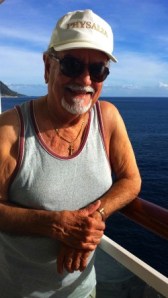
Dr. Juan Figueroa

Dr. Juan Figueroa

It was a Swiss boat of registration with mostly an Italian crew.  The ship continued to approach. The waves were so big that at times the faces of the crew watching us sank below the line of the closest waves and then, as we watched, they pitched up to 30 to 40 feet above us.

The crew threw overboard rope mesh (Jacobs ladder). Several crew members jumped in when the raft sank below the deck. I jumped toward the ship and I grasped the mesh, but I could not climb. Someone grabbed me and pulled me on to the deck.  I fell on to the deck like a sack of rice. Several of the crew of Celerina jumped into the raft and climbed out with the women and injured.

At one point I found myself in a large room. It was the crew mess. Other survivors were sitting or leaning against a wall. I was offered a drink of brandy.

Some time passed. I was confused and did not believe what was happening. A crew member entered the room and asked, “Mr. Figueroa?”

“I’m … ,” I answered. Then he said … “A signora seeks for you.”

When the crewman finished with his message, I asked, “How many rafts have been collected?”

“One” he answered me, and left.

[Dr. Figueroa went on tirelessly for the next several days with little or no sleep, administering to the survivors without the aid of his eye glasses that were collected on the aircraft.

His final question about the number of rafts was an attempt to clarify the situation in his mind. All on board knew there were to be 5 life-rafts that opened automatically on impact. Two may have been destroyed with breaking off of the wing, but it seems that the should have been deployed automatically and available in any case. There were two more in the wing that was still in tact on the side closest to the sole survivor raft. It is said that an Air Force NCO, familiar with the mechanics of the aircraft set his mind to opening the closest raft storage-hatch on the left side. When he got there within seconds of impact the hatch on the wing was empty. No raft.

Passengers were so confident that five rafts were available for their safety, that Dr. Figueroa believed that he was boarding a different raft than the one his wife had found when he was pulled from the raging seas. He could hear her voice, but assumed that she was in another raft adjacent to the jumble of frantic passengers of which he was a part.

One of the paratroopers who was one of the first to make it to the life raft, deployed by Navigator Nicholson by hand from the rear door, heroically  proceeded to pull others to safety. Within a short while it became obvious that the raft was too small to properly handle so many survivors. He started shouting to those in the water that they should go to another raft. That raft, which was clearly dangerously overcrowded, turned out to be the only one available. In the darkness and ocean chaos, who would have known it was the only one, especially after being told so confidently that there would five.

One other note about rafts: They were far from being “automatically deployable.”They required a degree of skill and a considerable amount of muscle strength to inflate (Read navigator Sam Nicholson’s account of opening the raft thrown out the back door. Troopers who tried to help Nicholson were simply unable to do so.)

Dr. Figueroa may be the only person to raise the question 52 years ago. Others that night were in shock and probably delirious about being alive. A safety equipment inventory was no doubt the furthest thing from their minds.]



Posted in passengers | Tagged , , , , , , | 2 Comments

Reader comments generate new leads and information.

RE Post: About this site.
By Ken Skelton

Two survivors, Frank Ruffalo and Sam Vasquez, reunited at my home in Arizona today (May 11). Would you like a photo of them? [Editor’s Note: “Yes, certainly!”]

Vasquez and Ruffalo

Ditching survivors Samuel Vasquez of Phoenix, left, and Frank Ruffalo of Chicago, right,  do some “catching up” after 52 years on May 11 in Arizona.

*     *     *    *    *     *

RE Post: Paul R. Stewart – Lifted off rescue ship at Antwerp, Belgium

My name is Erik Stewart. My father is Paul Stewart. [see post of May 27, 2014] My brother and I have told him about the site. Please feel free to contact me if you would like to get a hold of my father. [Editor’s Note: “We have gotten in contact. I’ve looked for him for nearly three years. Thanks for the info Erik.”]

*     *     *     *     *     *

RE Post: Bonaventure: The invisible giant!
by Ken King Kincardine, Ontario Canada

I was a crew member of the Bonaventure at the time. I was a flight deck electrician on the Bonnie. I remember the situation quite well. I think the highlight was watching our two rescue helicopters, namely Pedro and Fallen Angel transferring survivors and deceased from the Celerina to the Bonnie The pilots had to align themselves between the masts of the Celerina and adjusting their machines to match the heaving seas which were quite rough at the time. Quite feat to say the least. After treating the injured survivors, we sailed for Shannon, Ireland and transferred the survivors and deceased to the Shannon airport for transfer back to the United States.

*     *     *     *     *     *

RE Post: World Crises Build in September 1962
by Gregory James Smith

It’s eery to read about 1962 in the context of the new cold war, troubles with Russia, a plane down at sea, etc.

*     *     *     *     *     *

RE Post: Robert Eldred: “The hand of God was at the controls of the plane.”
by Carol Hansen, surviving Stewardess

I remember Robert Elred and he is absolutely correct about Sam Nickolson. If it was not for Sam and God I would not be here today.

*     *     *     *     *     *

RE post: Melvin Baney: Just trying to do the right thing…
by Dianne (Hauntsman) Sperre

Melvin was my uncle, my mother Shirley, was Marjorie’s sister. I was only 2 when this tragedy occurred, so obviously I don’t remember any of the details. My mother and aunt Marjorie were very close, so my family spent a lot of time with the Baney family. I commend Joan and Jim for being so open in their narrative. In reading this article I got my first view of my uncle Red. Wow, Jim and Gene really look like him.

*     *     *     *     *     *

RE post: Richard M. Miskimen: Airman’s wife tells of tragic loss
by Mel Mushaney

Dick Miskimen was a very good friend of mine in So Georgia, he and went to New Philly for Xmas and I met his Mother, brother and sister, I still pictures of that trip. I send Xmas card to Dick’s Mother until one Dick’s sister told me she had died, if Dot or Karen read this hope they will contact me. Mel

*     *     *     *     *     *

RE post: About this site.
by Gordon Williams

Hello Fred, I’ve just found your site; very good; at the time I was on HMCS Bonaventure. Here are a few notes from my diary. “Sept 17, 1962 HMCS Bonaventure leaves Halifax, Nova Scotia with destroyer escorts Athabasca, Cayuga, Micmac, Nooka, and Crescent enroute Rotterdam.
Sept 24 2154Z received report of Flying Tiger Constellation ditching 320 miles NW;
76 passengers, Bonnie heading there at full speed with Athabasca,
Sept 25 0330Z Swiss ship Celerina sights rafts, “many survivors”
0400Z Bonnie launched Tracker aircraft; MV Anadina rescued some;
1330Z planes search area, Bonnie has 12 bodies aboard, 3 from Celerina, and
9 from Anadina, also 3 injured survivors , rest are on Celerina
16 missing, 48 survived, 12 dead
Sept 27 at Shannon, Ireland; bodies flown ashore by helicopters;

*     *     *     *     *     *

RE post: Richard M. Miskimen: Airman’s wife tells of tragic loss
by Patricia Leonard

How wonderful (and absolutely amazing) that Karen (former Mrs. Miskimen) found the website. Coincidence? I think not. The Lord works in mysterious ways. Perhaps Richard guided her to it. I like to think so, anyway.

*     *     *     *     *     *

RE Post: Ditching of Flight 923 is an Atlantic ‘First’
by Henry Blake, Xenia, OH

I believe Karen nailed it. It’s amazing how anyone made it out alive from having to spend any time in such cold water. I filled a sink with water and added a few ice cubes to get the temp down to 40 degrees. My friend could only hold his hand in it for 5 minutes before pulling it out. I asked him if he thought he could swim in water that cold. He said, “Never”.

*     *    *     *     *     *     *

RE post: Skip Davidson: I knew it was swim or die.
by Sgt. Joseph C Whittington

I was at Fort Benning in Skip Davidson’s class and we all did not get orders to Germany. I went to
Fort Campbell, KY 101st ABN. I watched the Connie’s take off from Fort Benning and was sad not to be going to Germany.

*     *     *     *     *     *

Posted in flight crew, new combat troopers, passengers | Tagged , , , | 4 Comments

Paul R. Stewart – Lifted off rescue ship at Antwerp, Belgium

Pvt. Paul R. Stewart of Ardmore, Oklahoma, was one of the youngest paratroopers on board Flying Tiger 923 when it ditched in the frigid north Atlantic some 500 miles off the west coast of Ireland. It was a Sunday night, September 23, 1962. Stewart had enlisted within days of turning 17 years of age and had just graduated from parachute training at Ft. Benning, Georgia.

His mother, Mrs. Grace Stewart, got word early the following day, Monday morning, by telegram advising her that her son was in the crash and as yet was missing at sea and that rescue ships were on their way to pick up the bodies.

Paul Stewart

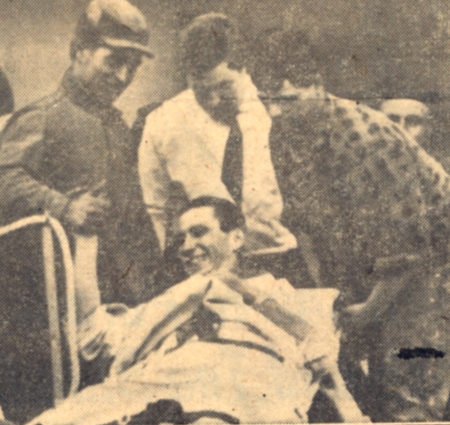
Paul Stewart grins as he is lifted off the rescue ship Celerina on a stretcher at the dock at Antwerp, Belgium. He suffered a deep cut on his right leg, which required a cast.

A reporter at the Daily Oklahoman news was the first to deliver the news late that same day that Paul was alive and on board the Swiss rescue ship, Celerina. Information on his condition was not then available.

Paul’s sister, Marguilla, answered the phone and when told her brother was rescued, broke down in tears of joy. His mother, Grace, said when called to the phone, according to the newspaper reporter, “Oh, it’s wonderful. I’ve worried and worried — ever since early this morning when we got the telegram.

“You don’t know how much I’ve … her voice trailed off.

“I’m so happy. That’s my baby you know,” she said.

Pvt. Steward suffered a deep cut on his left leg, but was not airlifted from the rescue freighter when it got close to Cork, Ireland. He remained on the Celerina until it arrived three days later at Antwerp, Belgium. He was taken off the ship on a stretcher, with his leg in a cast.

It didn’t take long for him to recover enough to continue to his assignment as a combat infantryman at Lee Barracks, in Gonsenheim, Germany (near Mainz). He served at that post for the next three years.

The writer of this blog story tried repeatedly to find he or his family, but unfortunately was unable to do so. The Stewarts of Ardmore 50 years later seemed not to be related and unable to lead to his whereabouts. The writer, Fred Caruso, and Paul were close associates at Lee Barracks, serving with the same unit, the 505th Airborne Infantry.

The information and notification scenario described above happened in a number of communities: tragic news of the crash delivered by telegram and joyful news by telephone from news reporters. The Army followed up with the good news by post some days later. None of the combat personnel reported their families having direct contact by Army officials delivering news or condolences in person.

Posted in new combat troopers | Tagged , , , , , | 4 Comments

Restoration Clubs Keep the Super Constellation Alive

Restoration clubs around the world are beginning to bring the Super Constellation back to life with hard work by a lot of volunteers and funds provided by generous sponsors.

A Swiss friend of “Flying Tiger 923”, Peter W. Frey, an adventurer and a freelance journalist from Hausen, Switzerland directed us to a treasure chest of Super

Peter Frey

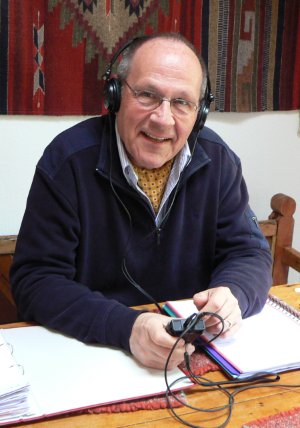
Peter Frey – Recording on Location

Constellation videos hosted on YouTube.com. In his recent travels, he met Captain Ernst Frei, a retired Swissair/Swiss captain who flies a beautifully restored Super Constellation L-1049F HB-RSC registered in Switzerland to the “Super Constellation Flyers Association” (SCFA), of which he is a member. The financial sponsor of this meticulous restoration project is the Breitling luxury watch brand. The aircraft is currently being used to transport VIP tourists to Swiss resorts.

Here is a 2 minute, five second close up video of the workings of the restored Breitling Super Constellation https://www.youtube.com/watch?v=VEaSDqxZVoY

You will find several clubs around the world working to bring “The Queen of the Atlantic” back to life. There are many videos posted. There is no charge for viewing them. Watch as many as you like. The videos run from less than 1 minute up to 7 to 8 minutes.

One particularly realistic video is “Flying in a Lockheed Constellation in the 1950’s”: https://www.youtube.com/watch?v=IrXgb8eZIxk

Poke around and be amazed to see how many videos there are. Can you find the video of flames at the rear of the Super Constellation?

Posted in Uncategorized | 1 Comment

Robert Eldred: “The hand of God was at the controls of the plane.”

Retired Army Captain Robert C. Eldred was one of the 17 survivors evacuated from the Swiss rescue ship Celerina by RAF Helicopter. He was interviewed on the tarmac of the new Cork Airport as rescue teams transported the injured to Mercy Hospital in downtown Cork. Captain Eldred is mentioned in a number of short news clips and in almost every case he devoted his words to giving praise to others (see story of Pvt. Willy Smith). The following is quoted from the Cork Examiner news of September 27, 1962, and is focused on him. It is probably the most detailed and accurate view of the Captain’s story:
*     *     *     *     *     *

‘The hand of God was at the controls of the plane.’ With those dramatic words retired US Army Captain Robert Eldred (49) of East Dennis, Mass., gave his reason why the 48 people were saved from the cold waters of the Atlantic when the airliner ditched in the sea after three engines failed, 500 miles off the west coast of Ireland. Continue reading

Posted in passengers, Uncategorized | 4 Comments

Flying Tiger 923 and the Raging North Atlantic – A Video

Taken in the same area of the North Atlantic on the afternoon of the very day of the demise of Flying Tiger 923 (Sept. 22-23, 1962), a 19-year-old crew member of the rescue ship Celerina, Pierre Andre Reymond took a two and a half minute long movie clip of the raging seas in which we ditched.

Click this link:   Flying Tiger 923 and Raging North Atlantic

Pierre Reymond

Pierre Reymond

The original was an 8 mm film was taken from the deck of the rescue ship only hours before the crash.

The storm and the seas grew more violent as the night wore on. The 51 passengers navigated the 10 to 15 foot waves and 35 foot swells for nearly six hours in an upside-down rubber life raft built to hold only 25. The overloaded raft was blown a distance of 22 miles in those six hours until it was intercepted by the Celerina. Forty eight survived the ordeal.

This video is astonishing. If you have not yet seen it, you must view it now.

Click this link:  Flying Tiger 923 and Raging North Atlantic

Thanks to Pierre-Andre, we are able to give readers an idea of conditions the night that cost the lives of 28. This video was first posted in June of 2012. It is being reposted as many new readers may not have seen it.

As of this posting, the video has had more than 1,300 views.

[Note: The reference to “September 22-23” is due to the flight crossing time zones. The crash occurred on September 23.]

Posted in Uncategorized | 1 Comment

Reader memories stirred by website stories

Reader comments suggest the value of this effort:
*     *     *     *     *

Barbara Murray,  barbaramurray63@hotmail.com
Hi there! I am Barbara Murray, daughter of John Murray. What an amazing story! And you know my dad and mom never really explained what happened. It was just considered that he was merely doing his job. I was only 5 when he died and would love to know more about the whole situation. My kids have read this about their granddad and are flabbergasted! My mail is barbaramurray63@hotmail.com
 I hope to hear from you.
*     *     *     *     *

Mary A. Gibson,  Leann2628@att.net
My family and I were scheduled to leave McGuire AFB in Sept 23, 1962; destination Frankfort, Germany. My husband was a Marine to be attached to the U.S Consulate in Frankfort. Our scheduled flight was on Flying Tiger 923 but my husband cancelled it and we took a later flight on American Airlines 707. Fate must have intervened on our behalf.
*     *     *     *     *

S. Robert Campbell,  karob@av.eastlink.ca
I was posted to the Bonaventure three years after the Flying Tiger accident. Men I worked with were onboard at the time of the rescue efforts and told many anecdotal stories concerning the ship’s role in the rescue/recovery efforts. One point about the story on this site – Bonaventure did not have Air Force pilots on board. Canada had a Fleet Air Arm in those days and the pilots on Bonnie were Naval Officers, the air crewmen were RCN ratings
*     *     *     *     *     *

Ragnar Domstad,  ragnar.domstad@gmail.com
I am the photographer of the N6923C. As Peter Frey mentioned, I don´t claim any copyright, but I ask to be mentioned as photographer. It is a strange feeling to know that “our” Super Connie ditched a year later. After fueling at Shannon, Ireland, we continued but had to land at Gander as the whole Eastern seaboard was closed due to fog. Reader memories stirred by website storiesSomewhat delayed, we arrived at Idlewild. As our study tour was a success, I was asked to arrange some more tours the following years, and in June 1962 we had another Super Connie chartered and a year later also.

When I first heard of the Flying Tiger Line, it was in a small notice in a newspaper. It said that Flying Tiger had passengers from the US to Europe in the beginning of the summer and vice versa at the end of the summer. They offered cheap charter flights from Europe in the beginning of the summer and back at the end of the summer to fill otherwise empty planes.
*     *     *     *     *

Paul Feldman,  paulhfeldman@gmail.com
I was 5 years old flying from McGuire to Paris in 1962 on this very plane. My father was a sergeant being transferred to Chalmount AFB. I remember several things.

1. We stopped in New Foundland and then made another stop in the Azores.

2. I remember seeing the exhaust flaming all night, I had a window seat.

3. When we were approaching Paris, the left #2 engine was shut down. I distinctly remember me and my brothers saying something to my father, to assure us, which was not true he said the pilot always shuts down engines when landing.

4. I remember my father telling us the plane crashed on its next trip.

Luckily, when we returned to McGuire in 1966 we were on a Pan Am 707.

Just thought I would share this.
*     *     *     *     *

Raymond Lewis,  raysco1@live.ca
Please verify (if I’m right) that the Canadian war ship H.M.C.S. Bonaventure and it’s 4 (four) Destroyer Escorts attended this tragedy. Some of the persons involved in this mishap were taken to the H.M.C.S. Bonaventure’s sickbay. The ships milk cooler was emptied and used as a morgue.

The Canadian ships then proceeded to Shannon Ireland. I was serving on the H.M.C.S. Bonaventure when this mishap occurred. Please if you can, verify this happening I would be so grateful to show my grandchildren the perils of the Atlantic.
Thank you
Raymond Lewis
*     *     *     *     *

Pierre Reymond, crew-member of the Swiss freighter Celerina reymondsurveys@gmail.com
Thanks for this excellent text. In my report on the Celerina,  I wrote some comments about Captain John Murray:

…. I attend to the aircraft’s Pilot who has a head wound. Soon he asks me if he can see our captain. I give him some rudimentary care and after he has rested a little, I go up with him on the bridge. No words are needed. The handshake of the two Captains is an emotional instant that reveals a lot about the thoughts of both men.

…. Personally, I made friends with John Murray, the pilot of the Super-Constellation, who was 44 years old then. Together we discussed the difficult decisions he had to make when the accident happened. Particularly, he had to choose whether to ditch “with” the waves or “against” them. Landing “with” a wave is generally preferable on one hand, but in that case the wind carries the plane with less airspeed and the aircraft may “fall” too roughly. The pilot finally chose the last solution intuitively and he worked with the wind as far as possible until the impact. “And if you had to do this over again?”, I asked. He said he would try to land as close as possible to a ship, provided one could ascertain its position.
 This conversation has remained in my memory, even though communication between air and sea and rescue methods have made a lot of progress nowadays.

Remember the state of the sea at the time of the ditching!
.
*     *     *     *     *

Kenneth D Stellon  barbken1825@yahoo.com
Just went to lunch with Frank Ruffalo who was a army paratrooper who survived this crash. He was relating his experience and mentioned Fred Caruso. What a fascinating and horrifying story! Frank is from Chicago. Our wives were best friends in grade school. They reconnected at a recent reunion. Although from the same neighborhood, Frank and I did not really know each other, but I remember others talking about his ordeal. He does not use the internet, but I plan to tell him about this web site. He did have a copy of the Saturday Evening Post story about the crash. It does make you realize the incredible sacrifices young people make as members of our armed forces. Thank you for this site.*     *     *     *     *

James L. Clark,  jclark31@cfl.rr.com
After more than 50 years since flying as a navigator with FTL my memories of flying on two of the four A/C that were lost in 1962 came flooding back, all spurred by hearing Carol recount her experiences at last year’s FTLPA convention.
 During 1962 I had over 160 hours in FT-923 and FT-913 over Mid and North Pacific routes. The loss of 913 was also the night of the loss of a good friend, Karl Rader, with whom I had spent time with hunting and fishing in Cold Bay during our stay overs.
 In 1964 I changed careers, obtained my pilot’s license and have since flown over 8,000 hours in the left seat.
 The six years flying for the Marine Corps and FTL provided me a great background within which to continue to use flying to further my business career. More importantly I had the pleasure of meeting and flying with my childhood hero’s of the original Flying Tigers, like Dick Rossi, Gil Bright, Ed Rector and Bob Neale.
 Safe journeys to you.

 *     *     *     *     *


Posted in Uncategorized | 2 Comments