A photo of Super Connie #N6923C — RIP

Swiss Journalist Peter W. Frey has just sent us a photo of the actual Super Constellation – #N6923C – the one that met its fate  in September 1962, under the banner of Flying Tiger 923. Here is the photo and what he had to say about it in his email of this August 1, 2012:

Super Constellation #N6923C – Photo by Ragnor Domstad, June 1961, on the tarmac of Gothenburg (Sweden) Torslanda airport.

I at last found a picture of the actual Super Constellation involved in the ditching, registration N6923C!! it was taken in June 1961 on the tarmac of the old Gothenburg (Sweden) Torslanda airport. The photographer was Ragnar Domstad, then a junior at Chalmers Technical University in Gothenburg. He was the organizer of a charter flight to the US for his fellow students during the summer break at the university.  I have been in contact with Ragnar and the picture can be used freely – he does not claim any copyright.” Continue reading

Posted in Uncategorized | Tagged | 5 Comments

Fred Caruso: Thank God I’m alive!

Some survivors wrote letters to describe the crash of Flying Tiger 923. One such letter was written the day following the disaster, September 24, 1962, while still at sea aboard the Swiss rescue ship, The  Celerina.

Pvt. Fred Caruso, newly graduated from combat paratrooper training, of Nanuet, N.Y., wanted to tell his family what happened to him and at the same time capture the emotion and feelings of the horror while still fresh in mind.

At age 21, he was one of the 17 injured survivors who were shuttled from The Celerina, then positioned only eight miles off the Irish coast at Galley Head, to the Cork Airport, some 30 miles east. He was on his way to Mercy Hospital. Continue reading

Posted in new combat troopers | Tagged , , , , , | 1 Comment

Lack of lighting weighs in on death toll

Refusal of US to Require Lights
Weighed as Factor in Airliner Death Toll

By Richard Witkin for wire services
From the New York Times

The role played by a flashlight in the rescue of survivors of the airliner crash in the Atlantic Sunday night raised the question why United States airlines are not required to equip individual life vests with lights. Continue reading

Posted in flight crew, passengers, rescue teams, Uncategorized | Tagged , | Leave a comment

Peter Foley: Stars and Stripes reporter tells the world of terror and survival

Peter Foley

Peter Foley

Much of what the world knows about the drama and details of the demise of Flying Tiger 923 is the result of the writing of US Stars and Stripes newspaper reporter Master Sergeant Peter Foley, home-town Spokane, Washington. Foley was aboard the aircraft on his way back to Germany. Foley will always be known for his enthusiasm, cheerfulness and helpfulness throughout the tragedy as well as his skill and sensitivity as a feature writer.

Relatively little is known about Peter’s personal life, except that his home town was Spokane, Washington. His wife’s name is Mary and at the time they had three children ranging in age from 15 months to 10 years. They lived in Darmstadt which is the European headquarters of the Stars and Stripes newspaper. Foley, 45 at the time, served for a period in World War II as an aircraft mechanic.

Perhaps the best way to know about Peter Foley, in the absence of information, is to read his writing. The following is one of his very first stories about the event:

From the New York Times:
Story By Master Sgt. Peter A. Foley, Stars and Stripes

On BOARD THE SS CELERINA, OFF IRELAND, Sept. 25, 1962 (UPI) – The battered survivors of the crash at sea Sunday have only praise for those responsible for their lives. Four hours after take-off from Gander, Newfoundland, at the point of no return, two engines had to be feathered [shut down]. The No. 1 had a runaway prop, and No. 3 had caught on fire.

Althought he plane still had two engines and could fly for a long time, the stewardesses began a ditching drill.

Spirits were high on the plane, and many of the young soldiers aboard – mostly headed overseas for the first time – kidded the stewardesses and said they wanted to be in the same life raft with them.

Bride Weeps

Near the rear of the plane sat a newly married couple. The bride, on one of her first flights, began to cry, and her young husband was telling her there was nothing to fear.

Real fear showed clearly in the eyes of the mother with two small children.

It was near 7 PM when No. 2 engine (one of the only two remaining) started to shower sparks. Then there was a loud thump and No. 2 was feathered.

It was the pilot’s – John Murray’s – turn to talk to the passengers and over the intercom speakers. The passengers heard, “We are going to ditch.”

One could feel the plane dropping now. Lights were turned out, so the eyes could get used to the darkness.

Then the announcement, “get ready to ditch,” and within minutes came the hard crash and struggle to get out of the sinking plane.

No Panic

There was no panic, just everyone moving to the escape hatches. The seas were rough and the wind was blowing and in the black of night nothing but the struggling swimmers could be seen.

Only the cries, “Where are the rafts? Where are the boats?” could be heard.

When on the left side of the plane a raft did drift by, it soon became p-acked as exhausted swimmers were pulled on.

In no time the wet and scared survivors were packed two deep in the 25-man raft.

For nearly five hours, this mass of humans was tossed around by the seas, often sprayed with cold water, and most of the time waist deep in water.

Hours passed slowly, and search planes overhead added much to the hope that help would soon be on the way. The raft was upside-down and all emergency equipment was out of reach.

Only a flashlight salvaged by Plane Captain Murray was on the raft and this proved to be the life-saving piece of equipment.

Only a few could move in the raft. Those in the center had to keep their heads above the water. Those along the sides had to try to help bail out the rising water.

It was the plane’s navigator, Samuel T. Nicholson, with a cap and plastic bag, who kept the water level down.

At no time did the sea or wind let up on pounding the raft. At times the raft would spin like a top and at others it would rise high on the crest of a wave, only to be dropped

It was when the raft was caught between two waves and almost folded in half that hurt the most; for this movement jammed the mass of survivors even tighter together and cause the most cries of pain.

The lights of the cirling plane on guard over the area kept spirits alive. Several lights on the distant horizon would bring shouts of “a ship is coming,” but most of these lights turned out to be the last light of flares dropped by the rescue planes.

The rising moon was first thought to be a ship on its way to help.

Ship’s Light Spotted

The first sure sign of help was when the green running light of this ship was spotted. It was almost an hour later when the ship’s searchlight — guided by the lone flashlight on the raft—spotted the raft.

The ship’s captain said, “If it was not for the flashlight, it would have taken much longer to find the raft.

It took more than two hours to get the 51 people aboard the ship. Most of the survivors suffered cuts and burns. All suffered from exposure.

During the first hours in the raft the survivors sang, tried joking and prayed. At no time did the majority lose hope. Even so, death claimed three lives and surely would have taken more if help hadn’t arrived when it did.
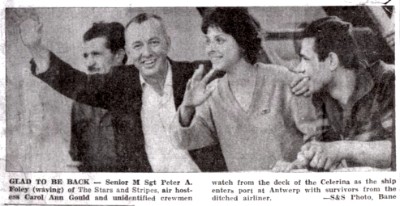
Peter Foley

FOLEY – Cheerful and Enthusiastic

In this photo, Foley is seen with surviving flight attendant Carol Ann Gould Hansen and unidentified crewmen on the deck of the Celerina as it pulls into the port of Antwerp, Belgium.

[If anyone knows of the whereabouts of Foley or members of his family, or anything at all about his post-military activity, please let us know via the blog comment area below.]

Posted in passengers | 5 Comments

Lois Elander: Captain says “get some lipstick for the lady!”

“When I was waiting on the deck of the carrier to take off to fly to Northolt (England), the captain shouted over the loud speaker that I was to bring lipstick back for the injured woman in the ship’s hospital. I couldn’t figure why she would need lipstick so soon after the rescue.”

Donald M. McLeod, commander of the squadron of Track Aircraft aboard the Canadian aircraft carrier Bonaventure, made those statements when he  flew into Northolt Airport, London, the night after the ditching of Flying Tiger 923. He had a film of the rescue operation and mentioned the young woman with a broken shoulder and injured back who had been taken on board of the carrier for emergency treatment. Continue reading

Posted in passengers | Tagged | 2 Comments

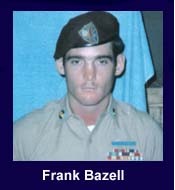
Frank Bazell: Survives crash to die another day for his country

Frank David Bazell, Van Nuys, California, was one of the lucky 48 who survived the ditching of Flying Tiger 923 that dreadful night of September 23, 1962. He made it out of the destroyed airplane, battled the frigid gale-driven waves of the North Atlantic, rode the upside-down and overcrowded life raft for nearly six hours, and was finally able to leave the rescue ship Celerina when it docked in Antwerp four days later. Continue reading

Posted in new combat troopers | Tagged , , | 4 Comments

Video – Raging Seas of the North Atlantic

YouTube Video:
Flying Tiger 923 and Raging North Atlantic

Gale force winds whipped the icy North Atlantic some 500 miles off the west coast of Ireland. Ocean swells rose up to 35 feet high and waves between 10 to 15 feet. One totally overcrowded, upside-down rubber life raft built for a maximum of 25 held 51 people from Flying Tiger Lines Flight 923 on its way to from Newark, New Jersey to Frankfort, Germany. Three passengers died in the raft during the 6-hour ordeal of tossing, turning and spinning, and constant dousing with iced cold seawater with each passing wave.

Forty eight passengers and crew of a total of 76 on board the aircraft survived the journey from their point of ditching to rescue by the Swiss Freighter Celerina.

One crew member, 19-year-old Pierre-Andre Reymond had an 8 mm movie camera and shot 2 minutes and 20 seconds of film of the growing storm, not knowing of the drama to come only 12 hours later. The storm worsened and lasted for four days.

Thanks to Pierre-Andre, we are able to give readers an idea of conditions that went on through the night that cost the lives of 28.

http://www.youtube.com/watch?v=U6wqjzs40EE&feature=g-upl

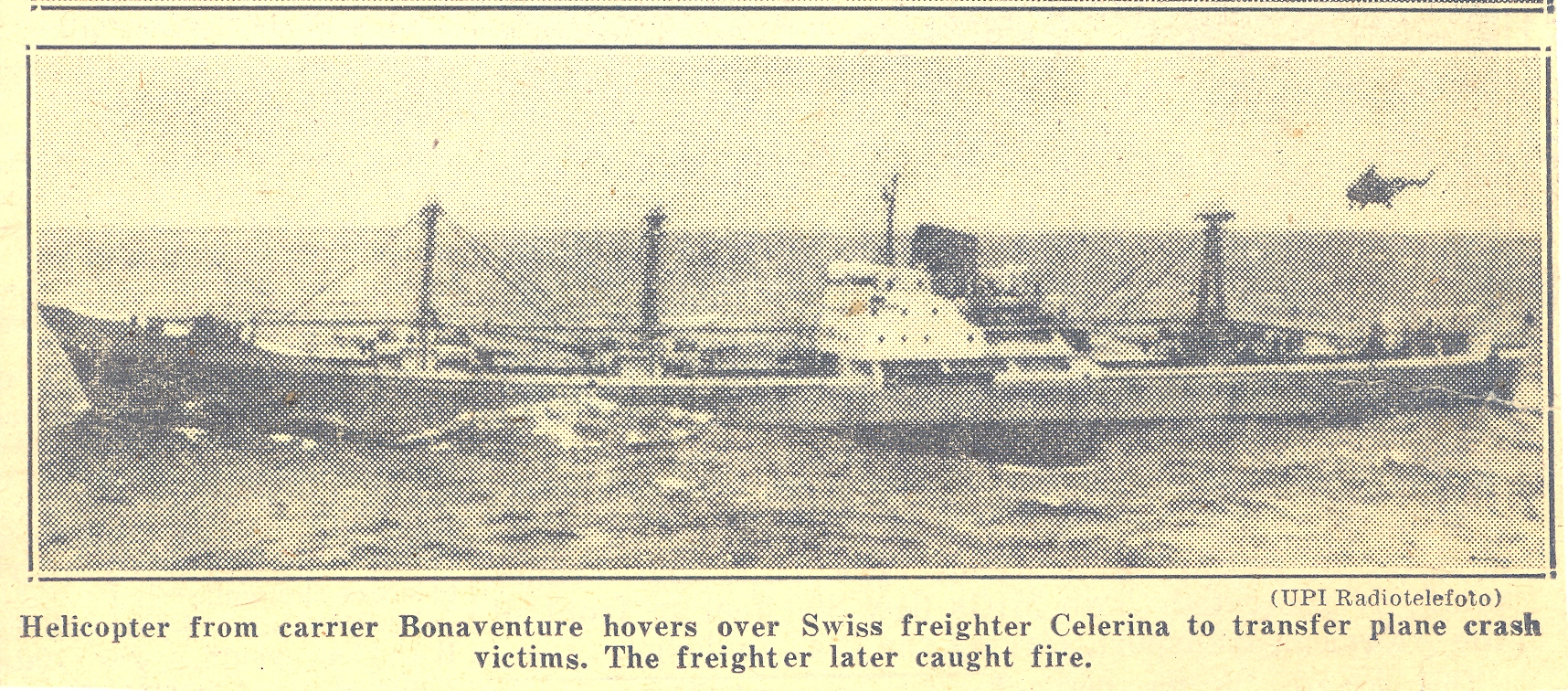
Swiss Freighter Celerina

150 x 19 meters (492 x 62 feet)

Above, the rescue ship, the Celerina. Video can be found on YouTube.com

Name of Video: Flying Tiger 923 and Raging North Atlantic


Posted in flight crew, new combat troopers, passengers, rescue teams | 7 Comments

The Luck of the Irish!

Irish Times, September 26, 1962 — Mr. Robert R. Ward, 26, of Kerrykeel, County Donegal, who was formerly in the R.A.F. arrived safely at Nutt’s Corner airport, County Leitrim, yesterday, thankful that he had cancelled his passage on the ill-fated Super-Constellation (Flying Tiger Flight 923)

He had booked a seat on the plane on his journey from Pennsylvania to Northern Ireland, but decided to cross the Atlantic on a later plane to give him time to meet some friends in Washington, D.C. He was greeted at the airport yesterday by his sister, Mrs. Jane Dowds, who was delighted to find him well.

Posted in Uncategorized | 1 Comment

John and Helga Groves: Pain of loss of friend lingers half a century!

Sgt. John and Mrs. Helga Groves

The close friend who drove the couple to McGuire Air
Force Base that day, September 23, 1962, says
“I feel the pain of the loss of this very good friend to this day after
nearly 50 years. Although the tragedy was many years ago, I am wondering if by some miracle of fate you may remember John or Helga and what may have happened to them that night.”

Continue reading

Posted in passengers | Tagged , , , | 7 Comments

How did the rescue ship get its name?

To many of the survivors of Flying Tiger 923, the name of the Swiss ship, Celerina, means “rescue, safety. survival and life.” But what is the true meaning of the name?   

Immediately after the ditching in late September 1962, several news reporters made reference to the name Celerina as meaning “The Swift One.”

We attempted to find the origins of the name by translating name from Italian, French, Spanish, Portuguese and German. None resulted in a meaning other than “Celerina.” In other words, Celerina in those languages simply means Celerina” (a name).

So, how did the ship get the name and does it have a meaning?

Our friend Pierre-Andre Reymond, who was a 19-year-old crew member of the Celerina at the time of the rescue, tells us how the name came about:

The shipping company, Suisse-Atlantique, was based in the Swiss state of Graubunden. That is the part of Switzerland where the “4th” Swiss language is used, the Retorromano or Romansh. This language is actually Latin. In use today it sounds a lot like Italian or Spanish. The three official languages of Switzerland, each dominating their own geographic region, are French, German and Italian.

Reymond said that the company chose the names of the villages of the State of Graubunden for their ships. Among them are Corviglia, Sils, Silvaplana, Bregaglia, and Celerina. He sailed on all of these ships during his tenure as a deck hand.

Our rescue ship was given its name after the village of Celerina ( 46° 31′ N / 009° 52′ E, altitude 1714 meters or 5623 feet) in the mountains close to Italy and neighboring the better known village of St Moritz. You can see what the village of Celerina looks like by clicking these links:

The Village:
http://www.tripwolf.com/en/galleries/media/ext/18006076/147284/Switzerland/Celerina?n=1#page=p10

Wikipedia Descriptions and Details:
http://en.wikipedia.org/wiki/Celerina/Schlarigna

 The major language of the Graubunden region today is German, however many people of the region still speak the Romansh language.  Approximately 1,500 people live in the village of Celerina, making their living largely through the tourism industry.

Reymond also noted that there is a flower of the “Acanthaceae” family named Celerina. There is no association there with the ship.

Celerina, he said, is a feminine name of Latin origin and the meaning in that language is “the speedy one” or “the quickest.” From that came the name dubbed by several journalists as “The Swift One.”

The Celerina, The Swift One, is a very nice name.

[Note: Pierre-Andre Reymond

Posted in rescue teams, Uncategorized | Tagged | 2 Comments